

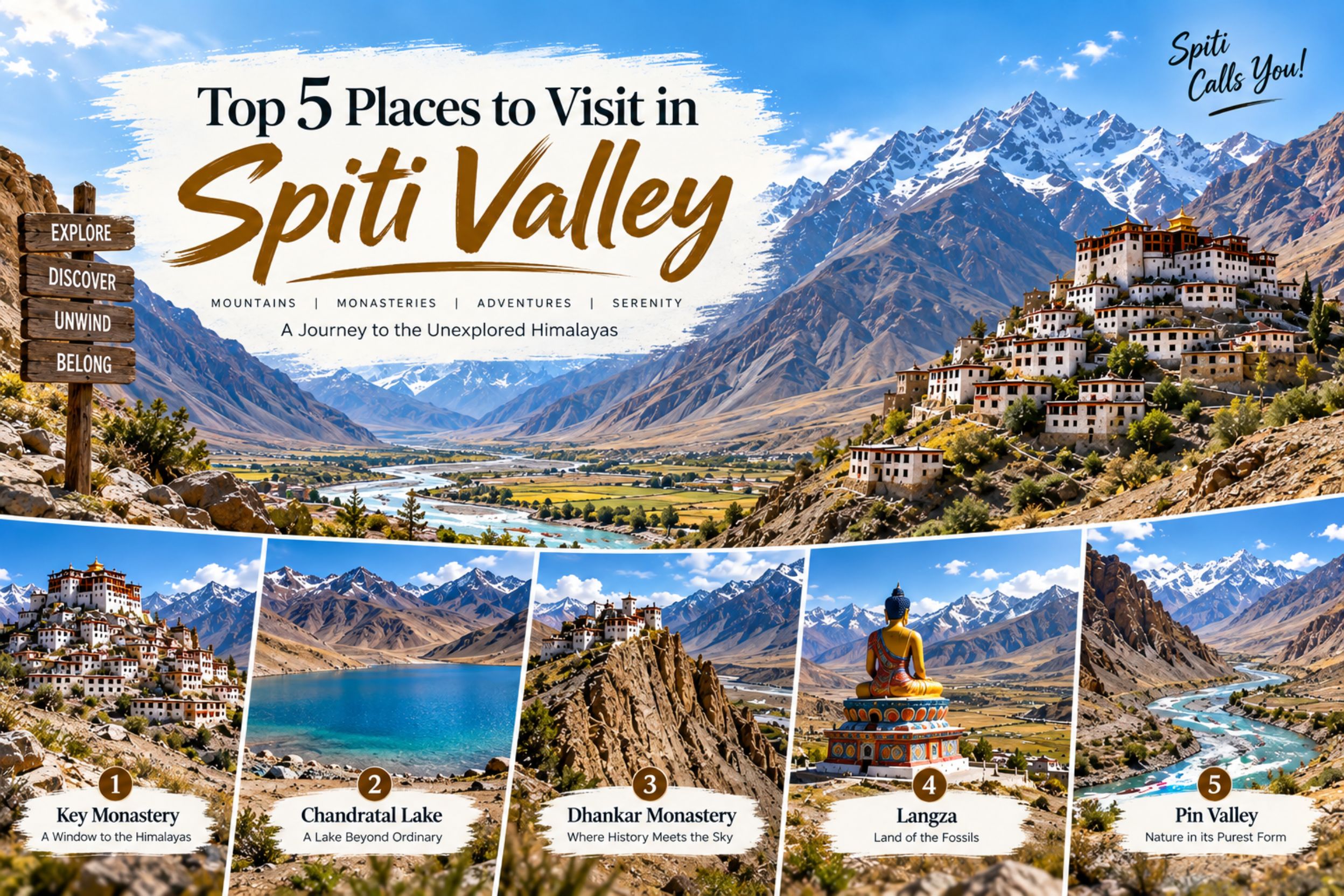
Top 5 Places to Visit in Spiti Valley
Spiti Valley is not a destination where you need to cover every village to have a worthwhile trip. The better approach is to choose a few major places that represent the valley's monasteries, mountain scenery, local settlements and high-altitude landscapes, then build your route around them.
If you are searching for the Top 5 Places to Visit in Spiti Valley, five places stand out for a first trip: Key Monastery, Tabo Monastery, Dhankar, Kaza and Chandratal Lake. They are different from one another, and together they give you a much better picture of what Spiti is about.
Key Monastery represents the valley's Buddhist heritage and dramatic mountain setting. Tabo Monastery is important for its age, murals and monastic architecture. Dhankar combines heritage with one of the most striking locations in the valley. Kaza is the practical centre for exploring nearby villages and attractions. Chandratal Lake adds a completely different landscape experience, although access is seasonal.
Himachal Tourism lists Key Monastery about 12 km from Kaza, Tabo about 48 km, Kunzum Pass about 75 km and Chandratal about 98 km from Kaza. These figures are useful for understanding the geography, but actual travel time depends heavily on road conditions, weather and the route being used.
Quick Answer: What Are the Top 5 Places to Visit in Spiti Valley?
For a first-time visitor, the five places worth prioritising are:
| Place | Best For | Approx. Position from Kaza | Ideal Visit |
|---|---|---|---|
| Key Monastery | Buddhist heritage, architecture, views | 12 km | 1–2 hours |
| Tabo Monastery | History, murals, culture | 48 km | 1.5–2 hours |
| Dhankar | Monastery, cliffs, valley views | Around 30–32 km | 2–3 hours |
| Kaza | Stay, food, local market, base for sightseeing | Main hub | Half to 1 day |
| Chandratal Lake | High-altitude lake and mountain scenery | Around 98 km from Kaza | Half/full day depending on route |
The distances above should not be treated as fixed driving times. Spiti is a high-altitude mountain region, and road conditions can change quickly. Himachal Tourism specifically recommends sturdy vehicles for travel from both the Manali and Shimla sides.
Which five should you choose if you have limited time?
If you have only three to four days around Kaza, prioritise Kaza, Key Monastery and Dhankar, then add Tabo if your route permits.
If you have a longer circuit and the Manali–Kaza side is open, Chandratal Lake becomes a logical addition.
This is one area where simply copying a "top 10" list from another travel website can lead to a poor itinerary. Several attractions can be combined geographically, while others require a substantial detour or depend on seasonal road access. Current competitor guides commonly list Key Monastery, Kaza, Tabo, Dhankar, Langza, Hikkim, Komic, Kibber, Chandratal and Kunzum Pass, but the practical value of each depends on your route and available days.
1. Key Monastery – The Most Recognisable Monastery in Spiti
For most first-time visitors, Key Monastery should be near the top of the places to visit in Spiti Valley.
Also written as Ki or Kye Monastery, it sits above the Spiti Valley and overlooks the Kaza area. The District Lahaul & Spiti administration describes it as the largest monastery in the valley, with a complex of interconnected rooms, corridors and prayer spaces. Himachal Tourism places it around 12 km from Kaza.
The monastery is not simply a viewpoint with a religious building on top. It remains an active centre of Buddhist learning. Its interiors contain murals, thangka paintings, manuscripts, stucco images and traditional instruments. The architecture is particularly interesting because the monastery developed as a compact, irregular structure adapted to the steep terrain.
Why visit Key Monastery?
Key Monastery is worth including because it combines three things that travellers generally come to Spiti for:
- Buddhist heritage
- Mountain architecture
- Wide valley views
The setting is especially important. From the monastery and surrounding roads, the scale of the Spiti landscape becomes much easier to appreciate than it does from Kaza itself.
How far is Key Monastery from Kaza?
Key Monastery is approximately 12 km from Kaza according to Himachal Tourism. The road connection makes it one of the easier major attractions to include in a Kaza-based sightseeing plan.
How much time should you spend there?
Allow roughly 1–2 hours, depending on whether you want only a short visit or time to appreciate the monastery and surrounding landscape.
Do not treat the place as a quick photo stop. Religious sites require respectful behaviour, and visitors should follow any instructions given by monks or local staff.
Best way to combine Key Monastery
Key Monastery works particularly well with:
- Kibber
- Chicham area
- Langza
- Hikkim
- Komic
This makes the Key Monastery side of the valley suitable for a dedicated Kaza day trip.
Expert tip
Do not build your schedule around an exact minute-by-minute plan in Spiti. Mountain roads, stops for photographs and weather conditions can change the pace of a day. Keep some buffer between major stops.
2. Tabo Monastery – A Major Heritage Site in Spiti
If Key Monastery represents the dramatic hilltop side of Spiti's Buddhist heritage, Tabo Monastery represents its older monastic tradition.
Tabo is one of the most important cultural stops in the valley. The monastery was established in 996 AD and its complex contains nine temples, chortens, monastic spaces and historic artwork. Both Incredible India and the monastery's own official website highlight its murals, statues and earthen architecture.
This makes Tabo one of the most important Spiti Valley tourist places for travellers interested in history rather than simply mountain views.
What makes Tabo different?
The first difference is its setting.
Key Monastery is dramatically positioned on a hill. Tabo Monastery sits within the settlement of Tabo, with its historic buildings integrated into the village environment.
The second difference is the art.
Tabo is known for its old murals, sculptures and Buddhist artwork. The official monastery website describes Tabo as an ancient earthen Buddhist monastery that has survived comparatively intact for more than 1,000 years.
The third difference is the historical depth.
The monastery is not a recently developed tourist attraction. It remains an active religious institution with monks, educational activities and preservation work.
How far is Tabo from Kaza?
Himachal Tourism lists Tabo at approximately 48 km from Kaza. The District Lahaul & Spiti website gives slightly different distances in different sections, which is normal for mountain-route measurements. Treat the distance as approximate rather than using it to calculate a rigid driving schedule.
How long should you spend in Tabo?
Plan around 1.5–2 hours for the monastery and village, with additional time if you are staying overnight.
Tabo can also be a practical overnight stop when travelling through Spiti from the Shimla–Kinnaur side.
What should visitors remember?
Tabo is an active religious and heritage site. Visitors should:
- Follow photography restrictions where applicable.
- Avoid touching artwork or old surfaces.
- Keep voices low inside religious spaces.
- Dress respectfully.
- Follow instructions from monastery authorities.
- Avoid treating the monastery as simply a photography location.
Expert tip
If you are entering Spiti through the Shimla–Kinnaur side, Tabo is much easier to incorporate naturally into your route than if you are doing a short Kaza-only trip.
That route logic is often missing from generic places to visit in Spiti Valley lists.
3. Dhankar – A Monastery Above the Spiti Valley
Dhankar deserves a place among the Top 5 Places to Visit in Spiti Valley because the attraction is not limited to its monastery.
Dhankar is known for its historic monastery and dramatic position above the valley. The District Lahaul & Spiti administration describes the settlement as an old strategic centre, while Himachal Tourism notes that the monastery once served as a fort and residence associated with the Nono, the traditional ruler of Spiti.
The combination of history and geography makes Dhankar different from Tabo and Key.
Why is Dhankar worth visiting?
There are three main reasons:
- Historic architecture
- Cliffside setting
- Views across the Spiti landscape
The monastery contains Buddhist scriptures and traditional religious artwork, while its location provides an immediate sense of why the settlement had strategic importance in earlier periods.
Dhankar also provides access toward Dhankar Lake and the Pin Valley area, making it useful as part of a broader sightseeing route.
How far is Dhankar from Kaza?
The District Lahaul & Spiti website places Dhankar about 32 km downstream from Kaza, while other official tourism material gives different route measurements. The difference reflects the fact that mountain distances depend on the exact road and reference point.
How long should you stay?
A reasonable visit can take around 2–3 hours, especially if you include viewpoints and allow time for the approach.
Do not pack Dhankar into an already overloaded sightseeing day. The combination of high altitude, mountain roads and walking can make short-looking distances take longer than expected.
Who should prioritise Dhankar?
Dhankar is particularly suitable for:
- History enthusiasts
- Architecture lovers
- Photographers
- Travellers interested in Buddhist culture
- People who prefer quieter heritage locations
Dhankar vs Key Monastery
| Factor | Dhankar | Key Monastery |
|---|---|---|
| Main attraction | Historic monastery and location | Monastery and Buddhist heritage |
| Setting | Cliffside/valley | Hill above Spiti |
| From Kaza | Shorter route | Around 12 km |
| Best combined with | Tabo, Pin Valley | Kibber, Langza, Hikkim, Komic |
| Experience | Heritage + landscape | Heritage + architecture + views |
If you have time for both, there is little reason to choose only one. They offer distinctly different experiences.
4. Kaza – The Practical Centre of Spiti Valley
Many lists of best places to visit in Spiti Valley treat Kaza as just a place to sleep.
That is too simplistic.
Kaza is the administrative headquarters and largest settlement in Spiti. It functions as the practical base for exploring many nearby attractions, including Key Monastery and the villages around the Kaza side of the valley. Himachal Tourism notes that Kaza has restaurants, banking facilities, an ATM, a post office and a fuel station.
For a first-time visitor, Kaza is important because it provides the infrastructure needed to explore the surrounding region.
What can you do in Kaza?
A Kaza day can include:
- Walking around the local market
- Trying local Tibetan-influenced food
- Shopping for local handicrafts
- Organising transport for nearby villages
- Resting and acclimatising
- Planning visits to monasteries
- Checking current road conditions
- Purchasing essential supplies
Kaza also gives travellers access to nearby villages such as Langza, Hikkim and Komic.
Why is Kaza important for acclimatisation?
Altitude should be treated seriously in Spiti.
Kaza itself is at a high elevation, and visitors coming from lower-altitude cities can feel the change in oxygen availability. Instead of immediately filling the first day with long drives and physical activity, it is sensible to keep the first part of the trip relatively easy.
That is not a luxury. It is practical travel planning.
How many days should you stay in Kaza?
For a broader Spiti trip, 2–4 nights in or around Kaza can provide a useful base for nearby sightseeing.
The exact number depends on your overall route.
For example:
Short trip:
- Day 1: Arrive and rest
- Day 2: Key Monastery + nearby villages
- Day 3: Dhankar + onward travel
- Day 4: Tabo or return route
Longer trip:
- Day 1: Arrival and acclimatisation
- Day 2: Key Monastery + Kibber
- Day 3: Langza + Hikkim + Komic
- Day 4: Dhankar
- Day 5: Pin Valley or additional local sightseeing
- Day 6 onward: Continue according to route
Kaza is also a logistics point
This is one of the most useful practical points for anyone researching Spiti Valley sightseeing.
Before leaving Kaza for a remote area, check:
- Fuel availability
- Weather
- Road conditions
- Accommodation availability
- Mobile connectivity
- Food and water requirements
- Return timing
- Vehicle condition
Himachal Tourism warns that network connectivity in Spiti is limited and notes that BSNL generally works better than other networks in the region.
5. Chandratal Lake – A Seasonal High-Altitude Highlight
Chandratal Lake is the most different attraction in this list.
While Key, Tabo and Dhankar are strongly connected with Spiti's cultural and religious heritage, Chandratal is primarily a landscape destination.
Himachal Tourism lists Chandratal approximately 98 km from Kaza and identifies the Chandratal trek among the region's recognised trekking routes.
Why is Chandratal Lake worth visiting?
The lake is known for its high-altitude mountain setting and distinctive landscape.
It is particularly attractive to travellers who want:
- Mountain photography
- A high-altitude lake experience
- Trekking
- Open landscapes
- A different side of the Spiti–Lahaul region
However, Chandratal should not be treated like an attraction that is available in exactly the same way throughout the year.
Is Chandratal open throughout the year?
No.
Access is seasonal and depends on snow, road conditions and the opening of the relevant mountain passes.
The route connecting the Lahaul side with Kaza through Kunzum Pass closes for long periods during winter because of heavy snowfall. The District Lahaul & Spiti administration specifically notes that this road can remain closed for more than several months during winter.
This is why any article promising that Chandratal is always accessible is giving travellers incomplete information.
When should you visit Chandratal?
The practical season depends on the current road opening and weather conditions.
For most conventional Spiti road trips, the summer and early autumn months are more suitable. Himachal Tourism identifies June to early November as a generally good period for Spiti, while specific mountain-road access can vary.
Before travelling, verify current road conditions rather than relying on an old blog's opening dates.
Can you visit Chandratal on a short Spiti trip?
Possibly, but it depends heavily on your route.
If you are travelling from the Manali side and entering Spiti through Kunzum Pass, Chandratal can fit naturally into the journey.
If you are already in Kaza and have limited time, adding Chandratal may create a much longer travel day.
This is an important difference between a Spiti Valley itinerary designed around geography and one designed simply around a list of attractions.
How to Choose the Best Places to Visit in Spiti Valley
Not every traveller should follow the same sightseeing plan.
The right combination depends on your available time, route and interests.
| Traveller Type | Places to Prioritise |
|---|---|
| First-time visitor | Kaza, Key Monastery, Dhankar, Tabo |
| Short Kaza-based trip | Kaza, Key Monastery, nearby villages, Dhankar |
| Heritage-focused traveller | Tabo, Key Monastery, Dhankar |
| Photography-focused traveller | Key, Dhankar, Chandratal, Kaza surroundings |
| Manali-side road trip | Chandratal, Kunzum Pass, Kaza, Key |
| Shimla-Kinnaur-side route | Tabo, Dhankar, Kaza, Key |
| Longer Spiti circuit | All five plus Langza, Hikkim, Komic and Pin Valley |
This is why there is no universal "best" attraction in Spiti. A place that works perfectly on a Manali–Kaza route may be inefficient on a short Shimla–Kinnaur itinerary.
Best Time to Visit Spiti Valley
The best time to visit Spiti Valley depends on which route you want to use.
Himachal Tourism states that June to early November is generally a good period for visiting Spiti, while current route conditions remain important.
May
May can be a transition period.
The Shimla–Kinnaur side may be usable while higher passes and the Manali side can still be affected by winter conditions.
Do not assume that because one route is open, every Spiti attraction is accessible.
June to August
This is generally the main travel period.
Advantages include:
- Better road access
- More accommodation options
- Longer daylight hours
- Better access to major attractions
- Suitable conditions for most conventional itineraries
The downside is that popular areas can be busier.
September
September can be a useful month for travellers who want cooler weather and fewer peak-season crowds.
Road conditions still need to be checked before departure.
October and November
These months require more planning.
Weather becomes colder, daylight reduces and some routes begin closing because of snow.
Winter
Winter Spiti is a very different proposition from a conventional summer road trip.
Do not plan a winter trip using a summer itinerary and assume that every attraction will remain accessible.
How to Reach Spiti Valley
There are two main road approaches to Spiti.
Shimla–Kinnaur–Spiti Route
The eastern approach comes through Shimla and Kinnaur before reaching Spiti.
The District Lahaul & Spiti administration lists the Shimla–Kaza road at approximately 412 km, with a stated journey time of around 20 hours excluding an overnight halt.
This route is useful when:
- You want a gradual approach to higher elevations.
- You want to include Kinnaur.
- You are planning a longer circuit.
- The Manali–Kaza route is closed.
Manali–Kunzum–Kaza Route
The western approach connects the Lahaul side with Spiti through the high mountain passes.
This route provides access toward:
- Kunzum Pass
- Losar
- Chandratal
- Kaza
The major limitation is seasonality. The Kaza–Lahaul road through Kunzum Pass closes during winter for an extended period because of snow.
Which route should you take?
Rather than asking which route is universally better, ask:
Which route is open, practical and compatible with my itinerary?
For a circuit trip, many travellers prefer entering from one side and exiting through the other when road conditions permit.
How Many Days Do You Need for Spiti Valley?
For the Top 5 Places to Visit in Spiti Valley, rushing through the region is a mistake.
4–5 days
Possible, but tight.
You can cover the major attractions around Kaza, but you will have little flexibility for weather or road delays.
6–8 days
A more practical duration for a focused Spiti trip.
You can include:
- Kaza
- Key Monastery
- Dhankar
- Tabo
- Nearby villages
- One additional excursion
9–12 days
This gives you considerably more flexibility.
You can build a larger circuit and include:
- Kaza
- Key Monastery
- Kibber
- Langza
- Hikkim
- Komic
- Dhankar
- Tabo
- Pin Valley
- Chandratal, subject to access
The right duration depends heavily on your starting point. A Delhi-to-Spiti trip requires substantially more travel time than a traveller already staying in Himachal Pradesh.
Practical Travel Tips for Spiti Valley
1. Do not underestimate altitude
Spiti is a high-altitude destination.
Give your body time to adjust, especially after arriving from a low-altitude city.
Avoid planning intense physical activity immediately after reaching a high-altitude settlement.
2. Keep your itinerary flexible
Mountain travel does not work well with extremely tight schedules.
A road delay can affect an entire day's plan.
Keep at least some buffer in your itinerary.
3. Check road conditions before departure
This is particularly important for:
- Kunzum Pass
- Chandratal
- Manali–Kaza route
- Remote village roads
Current road status is more reliable than a blog post written several months earlier.
4. Carry cash
Kaza has banking and ATM facilities, but connectivity and payment options can be inconsistent farther away.
Do not depend entirely on digital payments.
5. Carry basic medicines and essentials
Medical facilities are limited compared with major cities. Himachal Tourism notes facilities at Kaza, Tabo and Kibber, but travellers should still carry their own basic requirements.
6. Do not depend completely on mobile connectivity
Himachal Tourism notes that connectivity is limited in Spiti and that BSNL generally has better coverage than other networks.
Download:
- Offline maps
- Booking confirmations
- Important phone numbers
- Route information
- Emergency contacts
before entering areas with weak connectivity.
7. Respect monasteries and local communities
Spiti is not an open-air theme park.
Many of its most important attractions are active religious institutions and living communities.
Visitors should respect:
- Religious practices
- Photography restrictions
- Local customs
- Private property
- Quiet areas
- Waste-management rules
Common Mistakes to Avoid
Trying to cover every village
Langza, Hikkim and Komic are close enough to combine, but adding every attraction to a short itinerary can make the trip unnecessarily exhausting.
Treating distances like normal highway distances
A 30 km mountain road does not mean a 30-minute drive.
Road quality, altitude, traffic, stops and weather all affect travel time.
Booking a fixed itinerary without checking seasonal access
Chandratal and Kunzum Pass are the clearest examples.
Check current conditions before finalising the route.
Spending too little time acclimatising
The desire to "cover everything" on day one is understandable but poor planning.
Ignoring return-route options
Spiti is not a destination where you should think only about reaching Kaza.
Your exit route matters just as much as your entry route.
Assuming every online distance is identical
Different sources may measure distances from different points or along different roads.
Use official sources for broad planning and local/current information for actual travel conditions.
Suggested 7-Day Spiti Valley Itinerary
If you want a balanced Spiti Valley itinerary, a seven-day structure can look like this:
Day 1 – Reach Kaza
Keep the day light.
- Check into accommodation
- Rest
- Short local walk
- Eat and hydrate
- Confirm next day's road conditions
Day 2 – Key Monastery Circuit
Visit:
- Key Monastery
- Kibber
- Nearby high-altitude villages depending on road conditions
Return to Kaza.
Day 3 – Langza, Hikkim and Komic
These villages can generally be planned as one sightseeing circuit rather than separate full-day trips.
Day 4 – Dhankar
Visit:
- Dhankar Monastery
- Surrounding viewpoints
- Dhankar Lake if conditions and fitness allow
Return or continue depending on your route.
Day 5 – Tabo
Travel toward Tabo and spend time at:
- Tabo Monastery
- Tabo village
- Nearby heritage areas
Day 6 – Buffer / Pin Valley
Use this day for:
- Pin Valley
- Additional Kaza sightseeing
- A missed attraction
- Rest in case of road delays
Day 7 – Exit Spiti
Your exit depends on the route and season.
If travelling via the Manali side and roads are open, the itinerary can instead be structured around Chandratal and Kunzum Pass.
Where Does Chandratal Fit Into a Spiti Itinerary?
Chandratal is best considered a route-dependent attraction rather than a mandatory Kaza day trip.
If travelling from Manali toward Spiti and the road is open, you can structure the journey around:
Manali → Lahaul → Chandratal → Kunzum Pass → Losar → Kaza
This makes geographic sense.
If you are travelling from Shimla through Kinnaur, a different structure works better:
Shimla → Kinnaur → Tabo → Dhankar → Kaza → Key Monastery → nearby villages
The second route naturally incorporates Tabo and Dhankar.
This route-based planning is one of the biggest practical differences between a useful Spiti article and a generic list of places to visit in Spiti Valley.
What Makes These Five Places Different?
The five attractions are not interchangeable.
| Place | Main Value | Time Required | Season Concern |
|---|---|---|---|
| Key Monastery | Buddhist heritage + views | 1–2 hrs | Moderate |
| Tabo | Ancient monastery + artwork | 1.5–2 hrs | Moderate |
| Dhankar | Heritage + dramatic location | 2–3 hrs | Moderate |
| Kaza | Base + local experience + facilities | Half–1 day | Lower than remote sites |
| Chandratal | Lake + high-altitude landscape | Half/full day | High |
This distinction matters when building a realistic Spiti Valley sightseeing plan.
If culture is your priority, spend more time around Key, Tabo and Dhankar.
If landscapes are your priority, allocate time for Chandratal and the surrounding mountain routes.
If convenience matters, Kaza should be your main base.
Are These Really the Only Places Worth Visiting?
No.
There are many other worthwhile Spiti Valley tourist places, including:
- Langza
- Hikkim
- Komic
- Kibber
- Pin Valley
- Kunzum Pass
- Losar
- Dhankar Lake
Current competitor guides commonly expand their lists to 10, 15, 17 or even 18 attractions. That broader approach is useful for detailed planning, but it does not mean every attraction deserves equal priority on a first trip.
For a first visit, the five selected here provide a balanced combination of:
- Heritage
- Culture
- Landscape
- Local life
- Practical accessibility
- Route diversity
Key Takeaways
- The Top 5 Places to Visit in Spiti Valley for a first trip are Key Monastery, Tabo Monastery, Dhankar, Kaza and Chandratal Lake.
- Key Monastery is approximately 12 km from Kaza and is one of the valley's major Buddhist centres.
- Tabo Monastery dates to 996 AD and is one of Spiti's most important heritage attractions.
- Dhankar combines historical importance with a dramatic mountain setting.
- Kaza is the main practical base for exploring central Spiti.
- Chandratal Lake is highly seasonal and should be planned around current road access.
- Do not build a Spiti itinerary only by looking at distances on a map.
- Keep buffer time for road conditions and weather.
- Acclimatisation is important at high altitude.
- Check current route conditions before travelling.
- For a longer trip, add Langza, Hikkim, Komic, Kibber, Pin Valley and Kunzum Pass according to your route.