

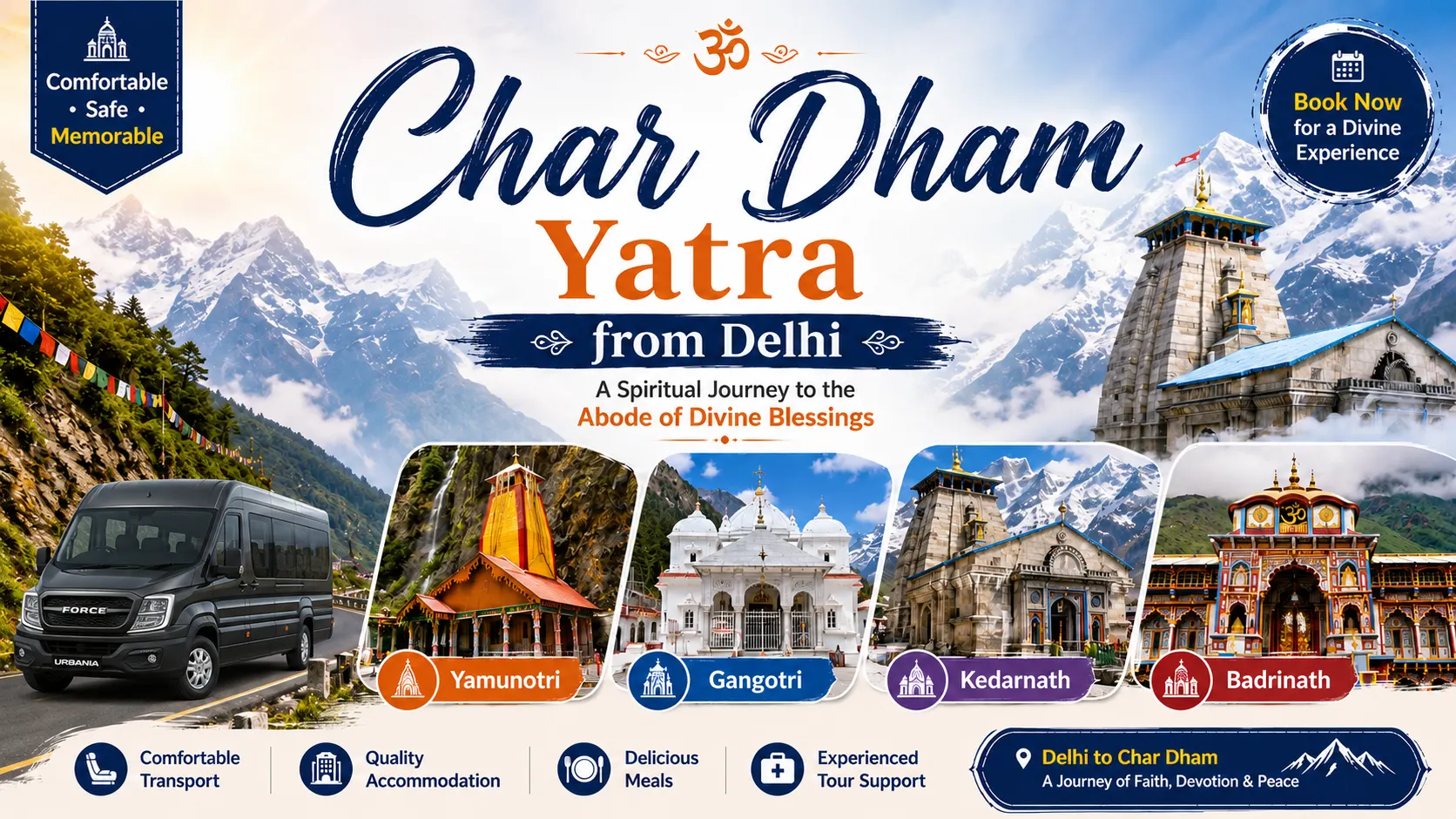
Char Dham Yatra from Delhi by Road
Planning 4 Dham Yatra from Delhi by road? This complete guide covers everything you actually need – the full route, an 11-day itinerary, honest cost breakdown, mandatory registration process, what to expect on the treks, vehicle options for your group size and practical tips that most travel guides skip.
What Is Char Dham Yatra and Why Do Lakhs of People Do It Every Year?
Char Dham Yatra is one of the most sacred pilgrimages in Hinduism. It covers four holy shrines nestled high in the Garhwal Himalayas of Uttarakhand:
- Yamunotri – origin of River Yamuna, first dham in the traditional sequence
- Gangotri – origin of River Ganga, second dham
- Kedarnath – one of the twelve Jyotirlingas of Lord Shiva, third dham
- Badrinath – dedicated to Lord Vishnu, one of the holiest temples in India, fourth and final dham
Completing all four dhams in one yatra is believed to wash away lifetimes of sins and guide the soul toward moksha. Beyond the spiritual significance, the journey passes through some of the most breathtaking Himalayan landscapes in the country – snow-capped peaks, deep river valleys, dense pine forests and high-altitude terrain unlike anything on the plains.
Every year, lakhs of pilgrims make this journey. The largest number of them start from Delhi – which is why Char Dham Yatra from Delhi by road is one of the most searched pilgrimage routes in India.
Total Distance: Char Dham Yatra from Delhi by Road
The complete Char Dham Yatra from Delhi by road covers approximately 1,800 to 2,000 kilometres for the full circuit, depending on exact stopovers and route variations.
| Dham | Distance from Delhi | Key Route | Trek Required |
|---|---|---|---|
| Yamunotri | ~430 km | Delhi → Haridwar → Barkot → Janki Chatti | 6 km trek |
| Gangotri | ~485 km | Delhi → Haridwar → Uttarkashi → Gangotri | No trek |
| Kedarnath | ~455 km | Delhi → Haridwar → Rudraprayag → Gaurikund | 19 km trek |
| Badrinath | ~525 km | Delhi → Haridwar → Devprayag → Joshimath → Badrinath | No trek |
Critical point most guides do not make clear enough: The road takes you to the base camp only for Yamunotri and Kedarnath. From those base points, you either trek or take a helicopter. Gangotri and Badrinath are fully motorable – your vehicle reaches the temple premises directly.
The Traditional Route Sequence – Follow This Order
The traditional and most auspicious sequence followed by pilgrims is west to east, starting at Yamunotri and ending at Badrinath. However, not every traveller completes all four dhams in one journey. Many families, senior citizens and working professionals now prefer a shorter 2 Dham Yatra from Delhi covering Kedarnath–Badrinath or Yamunotri–Gangotri in 5 to 7 days. A 2 dham trip reduces travel fatigue, lowers overall travel cost and is easier for pilgrims who cannot manage the complete 10 to 11-day Char Dham circuit.
Delhi → Haridwar → Barkot → Yamunotri → Uttarkashi → Gangotri → Guptkashi → Kedarnath → Joshimath → Badrinath → Rishikesh → Delhi
Why this order matters:
- Follows the traditional religious sequence considered auspicious
- Avoids unnecessary backtracking – saves significant driving time
- Road difficulty increases gradually – you build up to the more challenging mountain stretches
- Haridwar and Rishikesh act as natural rest and preparation points at the start and end
Key towns to know on this route:
- Haridwar / Rishikesh – gateway towns with the best hotel options, ATMs, medical facilities and travel services before you enter the mountains
- Barkot – overnight base for Yamunotri
- Uttarkashi – rest and acclimatisation stop before Gangotri
- Guptkashi / Phata – base for Kedarnath helicopter and trek
- Joshimath – last major town before Badrinath, good overnight stop
Day-by-Day Itinerary: 11-Day Char Dham Yatra from Delhi
This is a realistic, family-friendly pace – comfortable for senior citizens and families with children. Not rushed, not unnecessarily stretched.
| Day | Route | Distance | Highlights |
|---|---|---|---|
| Day 1 | Delhi to Haridwar | ~220 km | Har Ki Pauri, Ganga Aarti evening |
| Day 2 | Haridwar to Barkot | ~180 km | Kempty Falls en route |
| Day 3 | Barkot → Janki Chatti → Yamunotri → Barkot | 40 km drive + 12 km trek | Yamunotri Darshan |
| Day 4 | Barkot to Uttarkashi | ~100 km | Maneri Dam viewpoint, rest day |
| Day 5 | Uttarkashi → Gangotri → Uttarkashi | 200 km return | Gangotri Darshan |
| Day 6 | Uttarkashi to Guptkashi | ~220 km | Devprayag and Rudraprayag confluence |
| Day 7 | Guptkashi → Gaurikund → Kedarnath | 30 km drive + 19 km trek | Kedarnath overnight stay |
| Day 8 | Kedarnath Darshan → return to Guptkashi | Return trek + drive | Early morning darshan, less crowded |
| Day 9 | Guptkashi to Badrinath | ~200 km | Joshimath overnight if needed |
| Day 10 | Badrinath Darshan → Joshimath | Local | Mana Village, Vyas Gufa |
| Day 11 | Joshimath → Rishikesh → Delhi | ~480 km | Return to Delhi |
Day-specific notes worth knowing:
- Day 3 is physically the most demanding day of the first half – 6 km uphill trek at Yamunotri after a full morning drive. Start by 6:00 AM from Barkot.
- Day 7 is the hardest day of the entire yatra – 19 km trek to Kedarnath at 3,583 metres. Start from Gaurikund no later than 5:00 AM to reach before afternoon weather changes.
- Day 11 is a long drive back. Split it by staying in Rishikesh on Day 10 and returning to Delhi on Day 11 if your group is tired.
Need a 12 or 13-day itinerary with extra buffer days built in? Contact Luxury Urbania Hire Rental Delhi – we customise itineraries for group size, pace preference and senior citizen requirements.
Char Dham Yatra Registration 2026 – What You Must Do Before Leaving Delhi
Registration is mandatory. You will not be allowed entry at any of the four dhams without valid registration. The Uttarakhand government enforces this strictly – especially at Kedarnath and Yamunotri where daily visitor caps are in place.
How to register:
- Online – Official Uttarakhand Tourism portal: registrationandtouristcare.uk.gov.in
- Offline – Registration counters available at Haridwar, Rishikesh, Uttarkashi, Rudraprayag and Joshimath
Documents you need:
- Valid government photo ID – Aadhaar, Voter ID or Passport
- Passport-size photographs
- Medical fitness certificate – mandatory for pilgrims above 50 years of age
The warning most people ignore: During peak season from May to June, the daily quota for Kedarnath and Yamunotri fills up weeks in advance. If your registration slot is not confirmed, you will be turned away at the entry point even after completing the full drive and reaching the base camp. Register at least 4 to 6 weeks before your departure date during peak season.
Honest Cost Breakdown – What 4 Dham Yatra from Delhi Actually Costs in 2026
Most travel guides give vague ranges. Here is a real, transparent breakdown that includes costs people commonly miss:
| Expense Head | Budget Trip | Mid-Range Trip | Premium Trip |
|---|---|---|---|
| Vehicle hire (full trip total) | ₹35,000–50,000 | ₹60,000–90,000 | ₹1,00,000–1,50,000 |
| Accommodation per night | ₹500–1,500 | ₹2,000–4,000 | ₹5,000–12,000 |
| Food per day per person | ₹300–500 | ₹600–1,000 | ₹1,200–2,000 |
| Kedarnath trek / pony / palki | ₹3,000–6,000 | ₹6,000–10,000 | Helicopter ₹8,000–15,000/way |
| Registration and entry fees | ₹500–800 | ₹800–1,200 | ₹1,200–2,000 |
| Total per person (10–11 days) | ₹25,000–35,000 | ₹40,000–55,000 | ₹75,000–1,50,000+ |
Three specific costs that catch people off-guard every year:
- Hotels near the dhams cost far more than on the plains. A room that costs ₹800 in Haridwar costs ₹2,500 to ₹4,000 near Kedarnath base or Badrinath town. Limited supply, high demand – prices do not negotiate during peak season.
- Pony and palki at Kedarnath are not optional for everyone. If you are travelling with senior citizens or anyone with knee pain, heart conditions or breathing problems – ponies and palkis are necessary, not optional. Factor ₹6,000 to ₹10,000 per person into your budget before you leave Delhi.
- Helicopter services are more expensive than people expect. Kedarnath helicopter from Phata or Guptkashi runs ₹8,000 to ₹15,000 per person one way. Worth every rupee for senior citizens who cannot manage the 19 km trek – but plan the budget for it in advance.
Best Time for Char Dham Yatra from Delhi – and What to Avoid
The temples open in late April or early May on Akshaya Tritiya and close in October or November around Diwali. All four dhams shut completely in winter.
| Season | Road Conditions | Crowd Level | Recommendation |
|---|---|---|---|
| May – June | Best of the year | Peak – very crowded | ✅ Best for families and first-timers |
| July – August | Monsoon, landslide risk | Moderate | ⚠️ Risky – experienced travellers only |
| September – October | Good, cold nights | Thinner crowds | ✅ Best for experienced pilgrims |
The straight recommendation: First-time pilgrims travelling with family or senior citizens should go in May or early June. Roads are at their best condition, all services from medical support to accommodation are fully running and the weather is the most predictable of the season.
September and October are genuinely beautiful – thinner crowds, clear skies, dramatic mountain views. But temperatures at Kedarnath and Badrinath drop close to zero even in late September nights. Proper winter clothing is non-negotiable.
Avoid July and August. This is not a conservative suggestion – it is a real safety point. Landslides on mountain roads can close routes for 3 to 5 days without warning. Multiple groups of pilgrims have been stranded in previous monsoon seasons. This is not the right time for families or anyone doing this for the first time.
The Treks
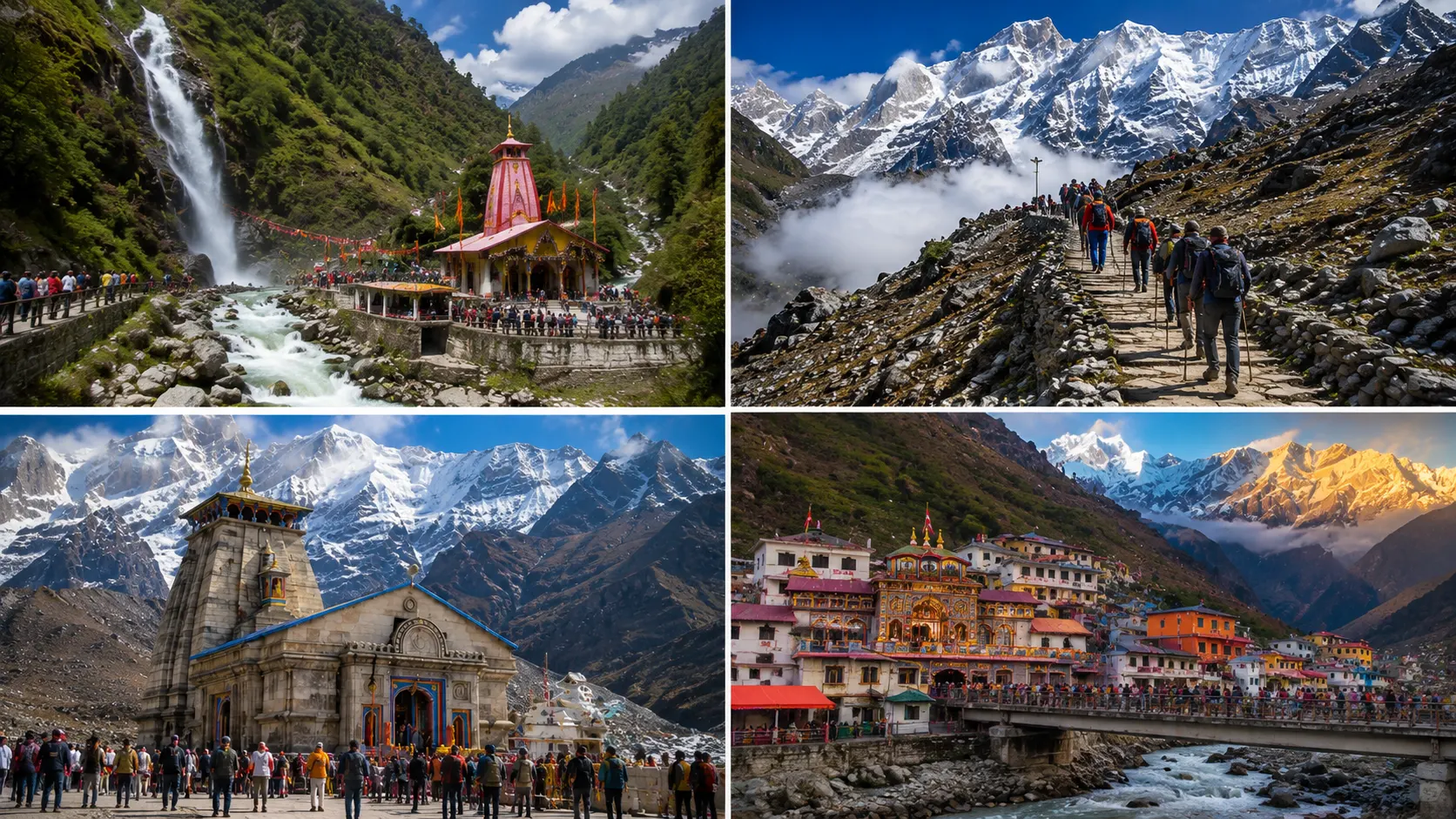
Yamunotri – 6 km each way from Janki Chatti
Moderate difficulty. Well-defined trail, rest points available every 1 to 2 km. A reasonably fit adult covers it in 2 to 3 hours. Pony and palki services available throughout. Most families manage this without major issues.
Kedarnath – 19 km each way from Gaurikund
This one is genuinely hard. It is 19 km uphill on a mountain trail at 3,583 metres altitude. Even fit adults experience breathlessness and fatigue. People with heart conditions, blood pressure issues, asthma or significant knee problems should not attempt this on foot – take the helicopter. Do not make the mistake of underestimating it because you are spiritually motivated. The altitude does not care about motivation. Thousands of pilgrims including young adults have struggled badly on this stretch.
Gangotri – No trek. Your vehicle drives directly to the temple.
Badrinath – No trek. Your vehicle drives directly to the temple.
Vehicle Choice for Char Dham Yatra from Delhi – Why It Matters More Than You Think
Char Dham Yatra from Delhi by road means 10 to 11 days of continuous mountain driving – steep gradients, constant hairpin bends, narrow stretches and uneven road surfaces that do not exist on plains highways. Your vehicle directly affects how tired or rested your group feels at every dham.
Arriving at Kedarnath base tired and stiff from 8 hours in a cramped seat is a completely different experience from arriving rested. Over a 10-day yatra, this difference compounds every single day.
| Vehicle | Capacity | Best For | Mountain Comfort |
|---|---|---|---|
| Sedan (Swift Dzire / Etios) | 4 passengers | Couples, 2–3 people | Decent – limited legroom and luggage space |
| SUV (Innova Crysta) | 6–7 passengers | Small families | Very Good – high ground clearance, reliable on mountain roads |
| Force Urbania | 10–12 passengers | Large families, groups | Excellent – built specifically for long-distance group comfort |
| Tempo Traveller (12 seater) | 12 passengers | Large groups | Good – spacious and economical |
| Tempo Traveller (17 seater) | 17 passengers | Very large groups | Good – best option for 15 or more people |
Why Families Are Choosing Force Urbania for Char Dham Yatra:
- Proper seat width and legroom – sitting for 7 to 8 hours on day 6 or day 9 in a cramped seat destroys energy. Urbania seats are genuinely wide.
- Suspension built for long-distance travel – mountain roads with constant turns and uneven surfaces are significantly less fatiguing in a vehicle with good suspension
- AC that performs at altitude – most standard vehicles lose AC effectiveness above 2,000 metres. Urbania maintains it better.
- Boot space for a 10-day family trip – warm clothes, trekking shoes, medical kits, prasad and 10 days of luggage for 8 to 10 people needs real boot space
- Everyone travels together – splitting a family into two cars creates coordination problems at every fuel stop, dhaba and rest point. One vehicle eliminates all of that.
One point no one tells you about drivers: Whatever vehicle you book, confirm that the driver has specific mountain driving experience on Uttarakhand routes. The roads toward Gaurikund and beyond Joshimath involve single-lane sections carved into cliff faces with sheer drops on one side. This is not the trip to discover your driver has never driven in the mountains.
For groups of 8 to 12 pilgrims travelling from Delhi, 13 Seater Force Urbania Rental offers the right combination of space, comfort and mountain reliability for a 10-day yatra.
Why Book Your 4 Dham Yatra Vehicle with Luxury Urbania Hire Rental Delhi
There are dozens of vehicle rental options in Delhi. For a trip where you are trusting a driver and vehicle with your family for 10 days on mountain roads, here is what actually separates a good booking from a bad one:
- Mountain-experienced drivers – our drivers have done the Uttarakhand Char Dham route multiple times. They know the sharp bends near Gaurikund, the road condition after Joshimath, where to stop for fuel before supply becomes patchy and how to handle overnight mountain driving safely.
- Vehicles checked before every long-distance trip – tyres, brakes, AC, suspension and engine are inspected before your trip departs. Not negotiable for a 10-day mountain journey.
- Pick-up from anywhere in Delhi NCR – Delhi, Gurgaon, Noida, Faridabad, Ghaziabad – wherever your group is assembling.
- Full price transparency before you book – the quote you receive is the price you pay. No surprise fuel surcharges, no mid-trip additions, no "extra charges for mountain roads."
- Reachable throughout the trip – if something comes up on the road, you can reach us. Not an automated response – a real person who knows your trip.
Vehicles available for Char Dham Yatra from Delhi:
- Force Urbania – for groups of 8 to 12
- Tempo Traveller 12 seater – for groups of 10 to 12
- Tempo Traveller 17 seater – for groups of 13 to 17
Tell us your travel dates, group size and pick-up location – we will send you a full transparent quote within a few hours.
Health Preparation – This Section Is Not Optional
A 10-day Himalayan pilgrimage involves high altitude, physical trekking, cold temperatures and daily long-distance travel. Preparation before you leave Delhi makes the difference between completing the yatra comfortably and struggling through it.
Before you leave:
- Full health check if you are above 45 or have any existing medical conditions
- Build basic walking stamina – 30 minutes of brisk walking daily for 3 to 4 weeks before the trip significantly helps on the Kedarnath trek
- Carry all prescribed personal medications plus a basic first-aid kit
At altitude:
- Ascend gradually – do not rush from Haridwar to Kedarnath in 2 days
- Drink more water than usual – dehydration accelerates altitude sickness faster than most people expect
- No alcohol during the yatra – it severely worsens altitude effects
- Descend immediately at signs of severe headache, nausea or breathing difficulty – do not wait to see if it passes
Medical facilities: Available at Haridwar, Rishikesh, Uttarkashi, Rudraprayag and Badrinath town. Basic health posts exist near Kedarnath base. Do not rely on any of these for serious conditions – carry your own medications.
Packing List for Char Dham Yatra from Delhi
You are moving between vehicles, hotels and mountain trails every 1 to 2 days. Pack light – but pack right.
Clothing:
- Warm woollen layers – temperatures drop close to zero at Kedarnath and Badrinath even in May nights
- Waterproof jacket – mountain rain arrives without warning at any point on the route
- Trekking shoes with ankle support – non-negotiable for the Kedarnath and Yamunotri treks
- Light cotton clothes for the Haridwar and Rishikesh sections
Documents and money:
- Original government ID – checked at multiple points on the route
- Printed and digital copies of your registration confirmation
- Sufficient cash – ATMs are available at Haridwar and Rishikesh but become unreliable past Uttarkashi and Rudraprayag
Health essentials:
- Personal medications
- Altitude sickness tablets (Diamox – consult your doctor before the trip on dosage)
- Sunscreen and lip balm – UV intensity at altitude is significantly higher than on the plains
- Reusable water bottles – refill at stops, avoid buying plastic at the dhams