

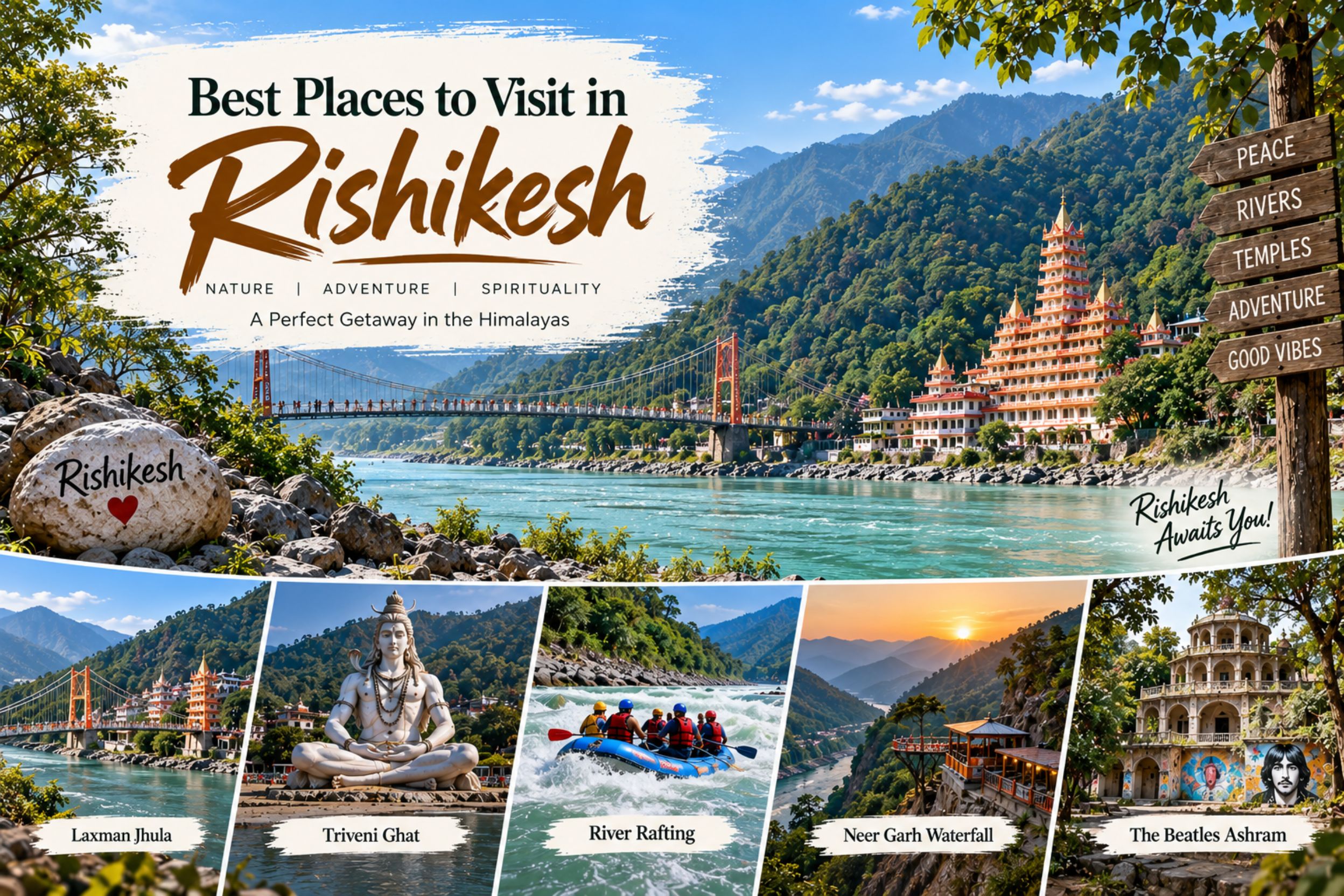
Best Places to Visit in Rishikesh
Rishikesh is one of those destinations where a short trip can include very different experiences. You can attend the evening Ganga Aarti, visit historic ashrams, walk beside the Ganga, explore waterfalls, visit hilltop temples or spend a day on the river.
For first-time visitors, the best places to visit in Rishikesh include Triveni Ghat, Ram Jhula, Beatles Ashram, Parmarth Niketan, Neer Garh Waterfall, Neelkanth Mahadev Temple, Kunjapuri Temple and the Shivpuri rafting area.
You do not need to visit every attraction in one trip. The better approach is to group places according to location and interest. Rishikesh works particularly well when spiritual sites, riverfront areas and adventure activities are planned on separate parts of the itinerary.
Uttarakhand Tourism itself highlights Rishikesh for its temples, ashrams, white-water rafting and Himalayan trekking access, while its suggested itinerary includes Laxman Jhula, Ram Jhula, ashrams and Triveni Ghat.
Quick Answer: What Are the Best Places to Visit in Rishikesh?
| Place | Best For | Approx. Time |
|---|---|---|
| Triveni Ghat | Ganga Aarti and spiritual experience | 1–1.5 hours |
| Ram Jhula | Ganga views and riverside walk | 30–60 minutes |
| Beatles Ashram | History, art and photography | 1.5–2 hours |
| Parmarth Niketan | Ashram and Ganga Aarti | 1–2 hours |
| Neer Garh Waterfall | Nature and short hike | 2–3 hours |
| Neelkanth Mahadev Temple | Temple visit and mountain drive | Half day |
| Kunjapuri Temple | Sunrise and Himalayan views | 3–4 hours |
| Shivpuri | River rafting and adventure | Half day |
| Tapovan | Cafés, yoga and relaxed evenings | 2–4 hours |
| Sivananda Ashram | Yoga and spiritual learning | 1–2 hours |
These attractions cover the main sides of Rishikesh: spirituality, river culture, history, nature and adventure. Current 2026 destination guides also identify these areas among the major attractions for first-time visitors.
1. Triveni Ghat
Triveni Ghat is one of the most important places to visit in Rishikesh, particularly if you want to experience the city's spiritual side.
The ghat sits beside the Ganga and is known for its evening Ganga Aarti, when lamps are offered to the river as part of the religious ceremony.
Uttarakhand Tourism specifically recommends keeping the evening free for Ganga Aarti at Triveni Ghat.
Why visit Triveni Ghat?
The attraction is not simply the ceremony itself.
Triveni Ghat gives visitors an opportunity to see an important part of everyday religious life in Rishikesh. Pilgrims visit the ghat for prayers and bathing, while travellers come to experience the evening atmosphere.
Best time to visit
The evening is the main attraction because of the Ganga Aarti.
Arrive before the ceremony rather than reaching at the last minute. The steps can become busy, particularly during weekends, holidays and major religious periods.
How much time do you need?
Allow approximately 1–1.5 hours.
If you want a good position for the Aarti, arrive earlier.
Good for:
- Families
- First-time visitors
- Pilgrims
- Photography
- Spiritual experiences
2. Ram Jhula
Ram Jhula is one of Rishikesh's best-known suspension bridges and an important connection between the riverside areas on opposite sides of the Ganga.
Walking across the bridge gives you views of:
- The Ganga
- Riverside ashrams
- Hills surrounding Rishikesh
- Boats and river activity
- Nearby temples and settlements
It is also a useful starting point for exploring the surrounding areas on foot.
Why visit Ram Jhula?
Ram Jhula is more than a viewpoint.
The surrounding area gives you access to several ashrams, temples, cafés and riverside paths, so it makes sense to combine the bridge with nearby attractions rather than treating it as a standalone stop.
Best time to visit
Morning and late afternoon are generally more comfortable for walking.
The area can become busy during peak tourist periods.
How much time?
Around 30–60 minutes for the bridge and nearby viewpoints.
Allow longer if you plan to explore the surrounding area.
3. Beatles Ashram
The Beatles Ashram, officially known as the Maharishi Mahesh Yogi Ashram or Chaurasi Kutia, is one of the most distinctive attractions in Rishikesh.
The Beatles stayed at the ashram in 1968 while studying Transcendental Meditation with Maharishi Mahesh Yogi. Their visit helped bring international attention to Rishikesh's spiritual culture. Government tourism documentation also notes the importance of the Beatles' 1968 visit in the development of Rishikesh's international reputation as a spiritual destination.
Today, the complex is known for its old meditation huts, murals, artwork and quiet forest setting.
What makes Beatles Ashram different?
It combines:
- Modern cultural history
- Meditation heritage
- Architecture
- Street-art-style murals
- Photography
- A quiet natural setting
The site is particularly interesting for visitors who want something different from temples and ghats.
How much time should you spend?
Plan approximately 1.5–2 hours.
Take your time walking through the different sections rather than rushing through the entrance area.
Best for:
- History lovers
- Photography
- International travellers
- Art enthusiasts
- Couples
- First-time visitors
Practical tip
Visit earlier in the day if you want a quieter experience.
4. Parmarth Niketan
Parmarth Niketan is one of the major ashrams in Rishikesh and is located beside the Ganga.
It is strongly associated with yoga, spiritual activities and the evening Ganga Aarti.
The riverside location makes it easy to combine with other attractions around the Ram Jhula and Swarg Ashram area.
Why visit Parmarth Niketan?
The attraction is useful for travellers who want to experience the ashram side of Rishikesh rather than simply visiting tourist landmarks.
You can experience:
- Yoga-related activities
- Spiritual programmes
- Riverside views
- Religious ceremonies
- Ganga Aarti
Parmarth Niketan vs Triveni Ghat
Both are associated with Ganga Aarti, but they offer different surroundings.
| Feature | Parmarth Niketan | Triveni Ghat |
|---|---|---|
| Setting | Ashram riverside | Major public ghat |
| Main attraction | Ashram + Aarti | Aarti + ghat |
| Atmosphere | Organised ashram setting | Public and pilgrimage-oriented |
| Best for | Spiritual/cultural experience | Traditional ghat experience |
You can visit both if your schedule allows.
5. Neer Garh Waterfall
If you want a break from temples and ashrams, Neer Garh Waterfall is one of the more practical nature attractions near Rishikesh.
The waterfall is surrounded by forest and requires a walk from the road.
The experience is less about a single viewpoint and more about the short hike and natural surroundings.
Current Rishikesh attraction listings describe Neer Garh as a two-tier waterfall and estimate around two to three hours for the overall visit.
Why visit Neer Garh Waterfall?
It is a good choice if you want:
- A short nature walk
- Waterfall views
- Forest surroundings
- A break from city sightseeing
- A relatively easy outdoor activity
How much time?
Keep around 2–3 hours, depending on walking speed and how long you stay near the waterfall.
What to carry
- Comfortable shoes
- Drinking water
- Light snacks
- Sun protection
- A small towel if you plan to get near the water
Avoid carrying unnecessary valuables.
Important note
Water conditions can change, particularly after rainfall. Do not enter fast-flowing water simply because other visitors are doing so.
6. Neelkanth Mahadev Temple
Located in the hills away from central Rishikesh, Neelkanth Mahadev Temple is an important Shiva temple and a popular excursion from the city.
The journey itself is part of the experience because the route moves away from the busy central areas and into the surrounding hills.
Why visit Neelkanth Mahadev Temple?
The temple is suitable for travellers interested in:
- Hindu pilgrimage
- Shiva temples
- Mountain roads
- Religious architecture
- Day trips from Rishikesh
How much time should you keep?
Plan a half-day rather than trying to squeeze the temple into a one-hour sightseeing slot.
The actual travel time depends on traffic, road conditions and your starting point.
Who should visit?
It is particularly suitable for:
- Pilgrims
- Families
- Religious travellers
- Visitors interested in local culture
7. Kunjapuri Temple
For panoramic mountain views, Kunjapuri Temple is one of the strongest options near Rishikesh.
The temple sits on a hill and is particularly popular for sunrise views.
Uttarakhand Tourism recommends Kunjapuri Temple as a stop on the route towards Tehri and notes its location around 25 km from Rishikesh.
Why visit Kunjapuri?
The main attraction is the viewpoint.
On clear days, visitors can see broad Himalayan and valley views from the temple area.
Best time to visit
Sunrise is the main reason many travellers make the early journey.
If you are visiting for sunrise, start early enough to reach the area before dawn.
How much time?
Allow approximately 3–4 hours, including travel and the climb.
Best for:
- Sunrise
- Photography
- Mountain views
- Temple visits
- Couples
- Nature lovers
8. Shivpuri – Best Area for River Rafting
Rishikesh is one of India's best-known destinations for white-water rafting, and Shivpuri is one of the main areas associated with rafting trips.
The rafting experience is not a conventional sightseeing attraction. It is an activity that can take several hours and should be planned separately from temple and ghat visits.
Uttarakhand Tourism identifies Rishikesh as a major white-water rafting centre.
Why choose Shivpuri?
Rafting routes vary in length and difficulty.
Before booking, check:
- Route length
- Rapid difficulty
- Minimum age requirements
- Weather
- River conditions
- Operator safety standards
- Included transport
Who should go rafting?
Rafting can suit:
- Adventure travellers
- Groups
- Young adults
- Families meeting operator age requirements
It may not be suitable for everyone.
Do not choose a rafting stretch purely because it is longer. Select one that matches your experience level and current river conditions.
9. Tapovan
Tapovan has a different character from the traditional ghat areas of Rishikesh.
It is known for:
- Yoga studios
- Cafés
- Guesthouses
- Wellness centres
- Backpacker accommodation
- Riverside and mountain views
Current travel guides consistently identify Tapovan as one of the main areas where visitors stay and spend time, particularly travellers interested in yoga and cafés.
Why visit Tapovan?
You do not necessarily visit Tapovan for one specific monument.
The neighbourhood itself is the attraction.
Spend a few hours walking around, visiting cafés and exploring yoga or wellness options.
Best for:
- Young travellers
- Couples
- Backpackers
- Yoga travellers
- Café hopping
10. Sivananda Ashram
The Sivananda Ashram, associated with the Divine Life Society, is another important spiritual institution in Rishikesh.
It is more suitable for visitors interested in yoga, meditation and spiritual learning than for travellers looking for conventional sightseeing.
The attraction should be approached respectfully because it functions as a spiritual institution rather than simply a tourist landmark.
Best for:
- Yoga practitioners
- Meditation
- Spiritual learning
- Visitors interested in Indian philosophy
If your main objective is sightseeing, you can prioritise the ghats and bridges instead.
11. Janki Setu
Janki Setu is another pedestrian suspension bridge over the Ganga and can be useful when exploring the riverfront areas.
It provides:
- River views
- Walking access
- Photography opportunities
- A quieter alternative to some of the busier crossing points
It can be combined with Ram Jhula, Parmarth Niketan and Swarg Ashram during the same sightseeing session.
Current 2026 travel guides identify Janki Setu among the active pedestrian crossings used by visitors, while also noting that the status of older bridges should be checked before planning around them.
12. Rajaji National Park
If you have an extra day and want to add wildlife to your Rishikesh trip, Rajaji National Park is another option.
The park covers a large forested area around the Shivalik hills and is known for wildlife experiences including elephant sightings.
However, do not add Rajaji National Park to a short two-day Rishikesh itinerary simply because it appears on a list.
It works better as a separate half-day or day excursion depending on the safari zone and schedule.
Best Places to Visit in Rishikesh for Different Travellers
Not everyone should follow the same sightseeing list.
For First-Time Visitors
Prioritise:
- Triveni Ghat
- Ram Jhula
- Beatles Ashram
- Parmarth Niketan
- Tapovan
These give you a balanced introduction to Rishikesh.
For Couples
Consider:
- Kunjapuri Temple
- Beatles Ashram
- Ram Jhula
- Neer Garh Waterfall
- Tapovan
For Families
Consider:
- Triveni Ghat
- Ram Jhula
- Parmarth Niketan
- Beatles Ashram
- Neelkanth Mahadev Temple
Add rafting only after checking the operator's age and safety requirements.
For Adventure Travellers
Prioritise:
- Shivpuri rafting
- Neer Garh Waterfall
- Kunjapuri
- Trekking routes
- Bungee jumping and other regulated adventure activities
For Spiritual Travellers
Prioritise:
- Triveni Ghat
- Parmarth Niketan
- Sivananda Ashram
- Neelkanth Mahadev Temple
- Ram Jhula
Best Places to Visit in Rishikesh in 2 Days
If you only have two days, do not attempt to visit 15 places.
A better itinerary is:
Day 1 – Spiritual and Riverside Rishikesh
Morning
- Ram Jhula
- Parmarth Niketan
- Riverside walk
Afternoon
- Lunch around Swarg Ashram or Tapovan
- Beatles Ashram
Evening
- Triveni Ghat
- Ganga Aarti
This gives you the main cultural and spiritual experience without spending the entire day travelling.
Day 2 – Nature and Adventure
Choose one main activity.
Option A – Adventure
- Shivpuri
- River rafting
- Return to Rishikesh
- Tapovan evening
Option B – Nature
- Neer Garh Waterfall
- Local sightseeing
- Kunjapuri Temple if timing permits
Do not combine too many distant attractions in one day.
Best Places to Visit in Rishikesh in 3 Days
Three days gives you more breathing room.
Day 1
Ram Jhula → Parmarth Niketan → Beatles Ashram → Triveni Ghat
Day 2
Shivpuri → River Rafting → Tapovan
Day 3
Kunjapuri Temple → Neer Garh Waterfall → Local sightseeing
If you prefer religious tourism, replace rafting with Neelkanth Mahadev Temple.
Best Time to Visit Rishikesh
The ideal time depends on what you want to do.
February to April
Good for:
- Sightseeing
- Outdoor activities
- Temple visits
- Walking
- Rafting, subject to current season and river conditions
May to June
The weather becomes hotter, particularly during the afternoon.
Early morning sightseeing is more comfortable.
July to August
Monsoon changes the character of the destination.
Heavy rain can affect:
- Road travel
- Hiking
- Waterfall visits
- Rafting operations
Do not assume rafting will operate normally throughout the monsoon.
September to November
This is a useful period for:
- Rafting when operations resume
- Outdoor activities
- Temple visits
- Mountain excursions
- Photography
December to January
The days can be pleasant, but mornings and evenings are cold.
This period works well for:
- Ganga Aarti
- Sightseeing
- Ashrams
- Cafés
- Spiritual retreats
How Many Days Are Enough for Rishikesh?
1 Day
You can cover:
- Ram Jhula
- Parmarth Niketan
- Beatles Ashram
- Triveni Ghat
But it will feel rushed.
2 Days
A good option for a short trip.
You can combine sightseeing with one adventure or nature activity.
3 Days
Better for first-time visitors.
You can include:
- Spiritual attractions
- Beatles Ashram
- River rafting
- Waterfall
- Kunjapuri or Neelkanth
4–5 Days
Useful if your focus is:
- Yoga
- Meditation
- Adventure
- Slow travel
- Multiple day trips
How to Reach Rishikesh
Rishikesh is well connected with Delhi and other major cities in North India.
Uttarakhand Tourism states that Delhi to Rishikesh is around 250 km by road, with an approximate driving time of around three hours under favourable conditions. Actual journey times can be longer because of traffic and road conditions.
By Road
Road travel is convenient for:
- Families
- Groups
- Weekend trips
- Private tours
By Train
Rishikesh has railway connectivity, while Haridwar is also an important nearby rail hub with more extensive train services.
By Air
The nearest major airport is Jolly Grant Airport in Dehradun.
From the airport, travellers can continue by taxi to Rishikesh.
Delhi to Rishikesh by Car
For travellers starting from Delhi, a private car or cab can be convenient because the journey is relatively straightforward compared with travelling to more remote Himalayan destinations.
A private vehicle allows you to:
- Choose your departure time
- Stop for meals
- Carry luggage easily
- Travel directly to your hotel
- Continue to nearby attractions
For families or groups, a larger vehicle can make the road journey more comfortable.
If several people are travelling together, a Force Urbania rental from Delhi can be considered instead of using multiple smaller cars.
This is especially relevant for:
- Family groups
- Corporate outings
- Friends travelling together
- Weekend group trips
- Multi-day Uttarakhand tours
Places Near Rishikesh You Can Visit
If you have more than three days, several nearby destinations can be added.
Haridwar
Good for:
- Har Ki Pauri
- Ganga Aarti
- Temples
- Pilgrimage
Kunjapuri
Best for:
- Sunrise
- Himalayan views
- Temple visit
Tehri
Good for:
- Tehri Lake
- Water activities
- Mountain scenery
Rajaji National Park
Best for:
- Wildlife
- Forest landscapes
- Safari
Do not try to cover all of these during a two-day Rishikesh trip.
Rishikesh Sightseeing: Common Mistakes to Avoid
Trying to visit everything
A long list does not automatically make a better trip.
Pick five to seven attractions based on your interests.
Treating every bridge as a separate attraction
Ram Jhula, Janki Setu and the surrounding riverfront areas can be grouped into one sightseeing block.
Ignoring travel time
Kunjapuri and Neelkanth are not central Rishikesh attractions.
Allow time for the road journey.
Planning waterfalls during poor weather
Heavy rain can change trail and water conditions.
Check local conditions before heading out.
Booking adventure activities only by price
For rafting, bungee jumping or similar activities, check the operator, safety standards, route, equipment and current operating conditions.
Overloading a one-day itinerary
Rishikesh is better experienced at a reasonable pace.
A realistic itinerary is more useful than a list of 20 check-ins.
What Should You Pack for Rishikesh?
Your packing list depends on the season and activities.
Basic items
- Comfortable walking shoes
- Light clothing
- Warm layer
- Sunglasses
- Sunscreen
- Reusable water bottle
- Personal medicines
- Identification documents
- Power bank
For adventure activities
- Quick-dry clothing
- Extra clothes
- Waterproof phone pouch
- Secure footwear
For temple and ashram visits
Wear comfortable, respectful clothing and follow the specific rules of each institution.
Best Places to Visit in Rishikesh: Final Shortlist
If you do not want a long sightseeing list, use this shortlist:
Must Visit
- Triveni Ghat
- Ram Jhula
- Beatles Ashram
- Parmarth Niketan
- Neer Garh Waterfall
Add If You Have More Time
- Kunjapuri Temple
- Neelkanth Mahadev Temple
- Shivpuri
- Tapovan
- Sivananda Ashram
This gives you a better balance than trying to visit every attraction mentioned in a generic Rishikesh travel list.
Key Takeaways
- Rishikesh combines spiritual tourism, river experiences, yoga, nature and adventure.
- Triveni Ghat is the main choice for experiencing the evening Ganga Aarti.
- Ram Jhula is ideal for river views and exploring nearby ashrams.
- Beatles Ashram is one of the most distinctive historical and cultural attractions.
- Parmarth Niketan is a good choice for visitors interested in yoga and spiritual activities.
- Neer Garh Waterfall offers a short nature excursion.
- Kunjapuri Temple is worth considering for sunrise and mountain views.
- Shivpuri is a major starting area for rafting experiences.
- Two days are enough for a short introduction, while three days allow a more balanced itinerary.
- If travelling from Delhi with a group, a private vehicle can simplify transport between Rishikesh and nearby attractions.
- Do not plan Rishikesh only as a checklist of tourist attractions. Group places by location and experience.